DETAILS
Written by: David Bowie, Carlos Alomar, John Lennon
Album: Young Americans
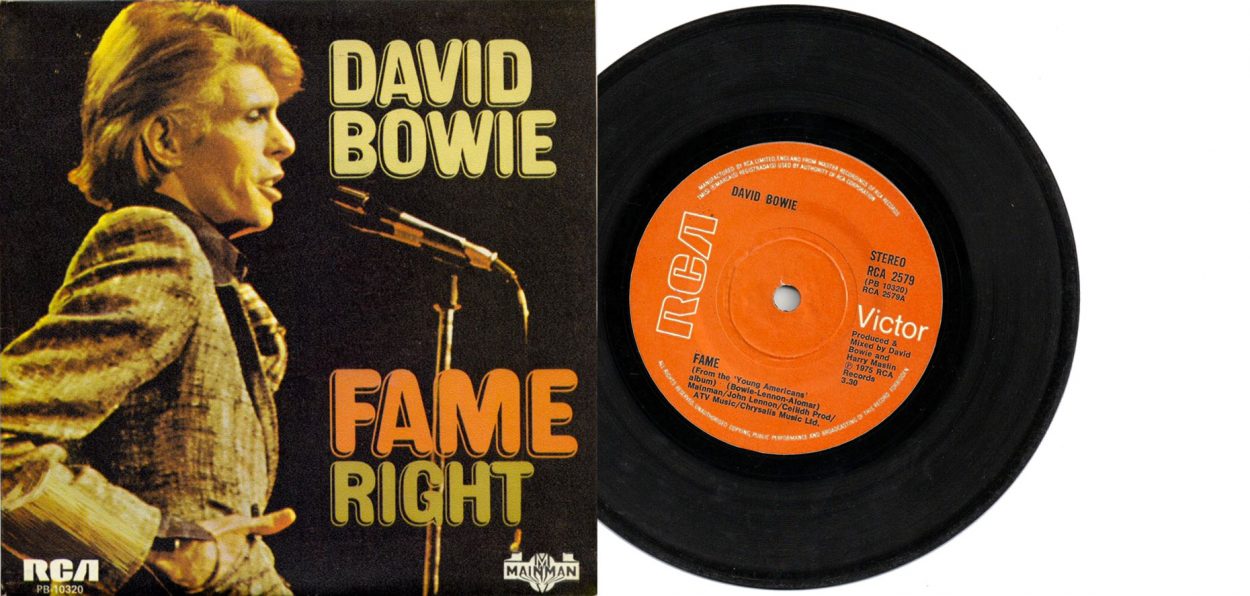
Released: 7 March 1975 (Album) / 25 July 1975 (Single)
B-side: Right
Recorded: Electric Lady studios, New York, January 1975
Length: 4:12 (album version), 3:30 (single edit)
Production: Harry Maslin, David Bowie
Musicians: David Bowie (vocals, guitar), John Lennon (vocals, guitar, tape loops), Carlos Alomar (guitar), Emir Kassan (bass), Dennis Davis (drums)
STORY
The story behind ‘Fame’
While mixing the Young Americans album in New York during January 1975, Bowie summoned members of his tour band for an impromptu recording session with John Lennon at Electric Lady studios. After taping ‘Across The Universe’, the band renewed their attempts to lay down a studio version of The Flares’ ‘Foot Stomping’, a staple in the previous autumn’s tour repertoire. However, the song which had worked so well in concert and during an appearance on the Dick Cavett show proved lacklustre in the studio, and Bowie elected instead to discard ‘Foot Stomping’ and salvage the guitar riff created by Carlos Alomar.
According to Alomar, “David recorded my chord changes and riff, and he hated it. He took out the lyrics and ended up with the music and cut it up on the master so that it would have classic R&B form. He’s a perfectionist and experiments with the original tape, running it backwards, cutting it up, doing things on the master as opposed to recording them live. ‘Fame’ was totally cut up. When he had the form of the song he wanted, he left. I stayed behind and overdubbed four or five different guitar parts on it. He listened to it and said, ‘That’s it’.”
Bowie would later question Alomar’s recollection of multiple guitar overdubs: “Carlos’s memory is a little off here,” he revealed in 2006. “Tony Visconti took the tapes to a studio for the 5.1 mix last year and found that Carlos had only overdubbed one extra guitar. The other electric guitar which makes the long ‘Wah’ and the echoed ‘Bomp!’ sound was played by myself, and John Lennon played the acoustic. John supervised the backwards piano on the front. I also spent several hours creating the end section.”
Like many of the Bowie classics, ‘Fame’ was clearly the product of a happy collision of accidents and methodologies. John Lennon later suggested in 1980 that “We took some Stevie Wonder middle eight and did it backwards, you know, and we made a record out of it! I like that track.”
“With John Lennon in the studio it was more the influence of having him that helped,” said Bowie. “There’s always a lot of adrenalin flowing when John is around, but his chief addition to it all was the high-pitched singing of ‘Fame!’ The riff came from Carlos and the melody and most of the lyrics came from me. But it wouldn’t have happened if John hadn’t been there. He was the energy, and that’s why he got a credit for writing it. He was the inspiration.”
‘Fame’ sums up Bowie’s (and indeed Lennon’s) very immediate disaffection with the trappings of stardom: money-grabbing managers, mindless adulation, unwanted entourages and the hollow vacuity of the limousine lifestyle. Having spent most of 1974 simultaneously touring America and fighting with his manager Tony DeFries over control of his finances and career, David was singing from the heart. There’s nothing abstract about lines like “what you need you have to borrow”, which precisely articulate David’s predicament in the dying days of the MainMan empire.
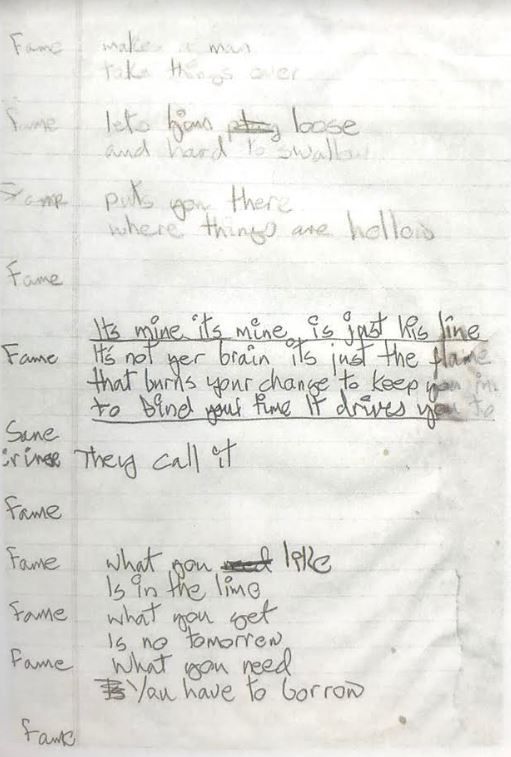
“There was a degree of malice,” Bowie later agreed. “I’d had very upsetting management problems and a lot of that was built into the song.” On another occasion he recalled that he and Lennon had “spent hours talking about fame, and what it’s like not having a life of your own any more. How much you want to be known before you are, and then when you are, how much you want the reverse: ‘I don’t want to do these interviews! I don’t want to have these photographs taken!’ We wondered how that slow change takes place, and why it isn’t everything it should have been. I guess it was inevitable that the subject matter of the song would be about the subject matter of those conversations.”
Despite its intensely personal nature, Bowie was initially unenthusiastic about ‘Fame’. “That was my least favourite track on the album,” he recalled in 1990, “even though John had contributed to it and everything, and I had no idea, as with ‘Let’s Dance’, that that was what a commercial single is. I haven’t got a clue when it comes to singles. I just don’t know about them, I don’t get it, and ‘Fame’ was really out of left-field for me.”
Ironically, ‘Fame’ was the Bowie single that finally broke America and propelled him into the full glare of Stateside celebrity. It became a US number 1 in the summer of 1975 before he had ever topped the chart in his home country, where the single managed a more modest number 17.
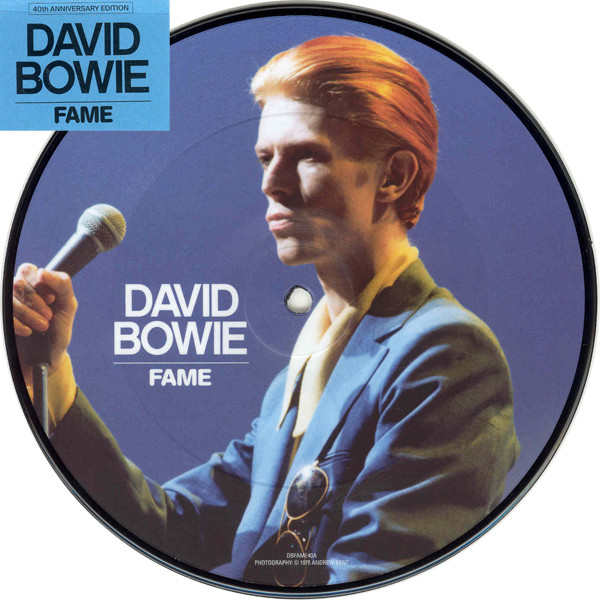
The 3’30” single edit has only appeared on one compilation to date, 1980’ s The Best Of Bowie, and the so-called “original single edit” released as a 7” picture disc in 2015 is a new and inauthentic creation). Two early studio mixes, timing at 3’53” and 4’17” respectively and both distinguished by a prominent flute line possibly played by backing singer and multi-instrumentalist Jean Fineberg, have appeared on bootlegs.
On 4 November 1975 Bowie gave a mimed performance of ‘Fame’, together with his latest single ‘Golden Years’, on ABC TV’s Soul Train. A fortnight later on November 23 he performed the song again (this time with a live vocal and a sax-heavy backing mix) on CBS’s The Cher Show. This clip, shot against a backdrop of twinkling Vegas lights, would subsequently become the unofficial “video” for ‘Fame’, despite being shot a good two months after the single’s chart success.
In January 1976 James Brown, one of Bowie’s boyhood idols, released a single called ‘Hot’ – followed two months later by an album of the same name – which was a blatant and un-sanctioned cover of ‘Fame’ with a few different lyrics. Apparently Bowie was flattered to have his work recorded by one of his heroes, yet at the same time dismayed by what he considered plagiarism; according to Carlos Alomar, he decided that “If it charts, then we’ll sue him.” However, in common with many of Brown’s mid-1970s offerings ‘Hot’ failed to chart, and all was forgotten.
In March 1990 a barrage of ‘Fame 90’ remixes by the likes of Arthur Baker and Jon Gass were released to spearhead the ChangesBowie album and the Sound + Vision tour. “It covers a lot of ground, ‘Fame’,” Bowie explained, “it stands up really well in time. It still sounds potent. It’s quite a nasty, angry little song. I quite like that.”
This time the single only reached number 28 in Britain and failed to chart in America, despite the additional publicity of theThe ‘Gass Mix’ version featuring in the Pretty Woman soundtrack. ‘Fame 90’ was by no means an improvement on the original, smothering its slinky funk sounds with gunshot percussion and fashionable scratch-mix effects.
The Cher Show performance was one of several archive clips used for Gus Van Sant’s ‘Fame 90’ video, in which miniature screens relaying past glories framed new footage of Bowie vogueing with Sound + Vision tour dancer Louise LeCavalier.
‘Fame’ featured on the Isolar, Isolar II, Serious Moonlight, Glass Spider, Sound + Vision, Earthling, summer 2000, Heathen and A Reality tours, making it one of Bowie’s hardiest perennials. He often adapted and augmented the number on stage: in 1983 he added a lengthy call-and-response sequence with the audience, while in 1987 he incorporated snatches of the Edwin Starr/ Bruce Springsteen hit ‘War’ (“ Fame –what is it good for? Absolutely nothing!”), the traditional folk-songs ‘London Bridge Is Falling Down’ and ‘Lavender Blue’ (“ I will be king, dilly dilly, you can have fame!”) and, bizarrely, ‘Who Will Buy?’ from Lionel Bart’s Oliver!.
During the early leg of the Sound + Vision tour ‘Fame’ segued into a live rendering of the ‘Fame 90 House Mix’. In a similar spirit the Earthling shows developed the line “Is it any wonder?” into a new drum’n’bass workout which soon acquired a life of its own, and when the original ‘Fame’ was revived on the same tour, splendidly dirty blasts of fuzzy guitar and spooky synthesized strings transformed the song from a rinky-dinky “greatest hit” back into the prowling monster it had once been.
WATCH
The video for ‘Fame 90’
Film director Gus Van Sant directed the promotional video for this version, which featured clips from many of Bowie’s previous videos. In the music video, Bowie also performs a dance with Louise Lecavalier, one of the main dancers of the Québécois contemporary dance troupe La La La Human Steps (whom Bowie would collaborate with on the Sound + Vision tour).
David Bowie’s ‘Fame’ was used as the soundtrack of an animated music video of the same title, directed by Richard Jefferies and Mark Kirkland while students at California Institute of the Arts. The film, released in 1975, went on to win the Student Academy Award for animation and aired on NBC’s The Midnight Special.
LISTEN
| Listen to the single edit | Listen to the album version |
LYRICS
‘Fame’ Lyrics
Fame makes a man take things over
Fame lets him loose, hard to swallow
Fame puts you there where things are hollow (fame)
Fame, it’s not your brain, it’s just the flame
That burns your change to keep you insane (fame)
Fame, (fame) what you like is in the limo
Fame, (fame) what you get is no tomorrow
Fame, (fame) what you need you have to borrow Fame
Fame, (fame) it’s mine, it’s mine, it’s just his line
To bind your time, it drives you to crime (fame)
Is it any wonder I reject you first?
Fame, fame, fame, fame
Is it any wonder you are too cool to fool? (fame)
Fame, bully for you, chilly for me
Got to get a rain check on pain (fame)
Fame
Fame, fame, fame
Fame, fame, fame
Fame, fame, fame, fame
Fame, fame, fame, fame
Fame, fame, fame
Fame, what’s your name?
Fame
ARTWORK
‘Fame’ Artwork
-

- David Bowie – Fame – 40th Anniversary Picture Disc
-

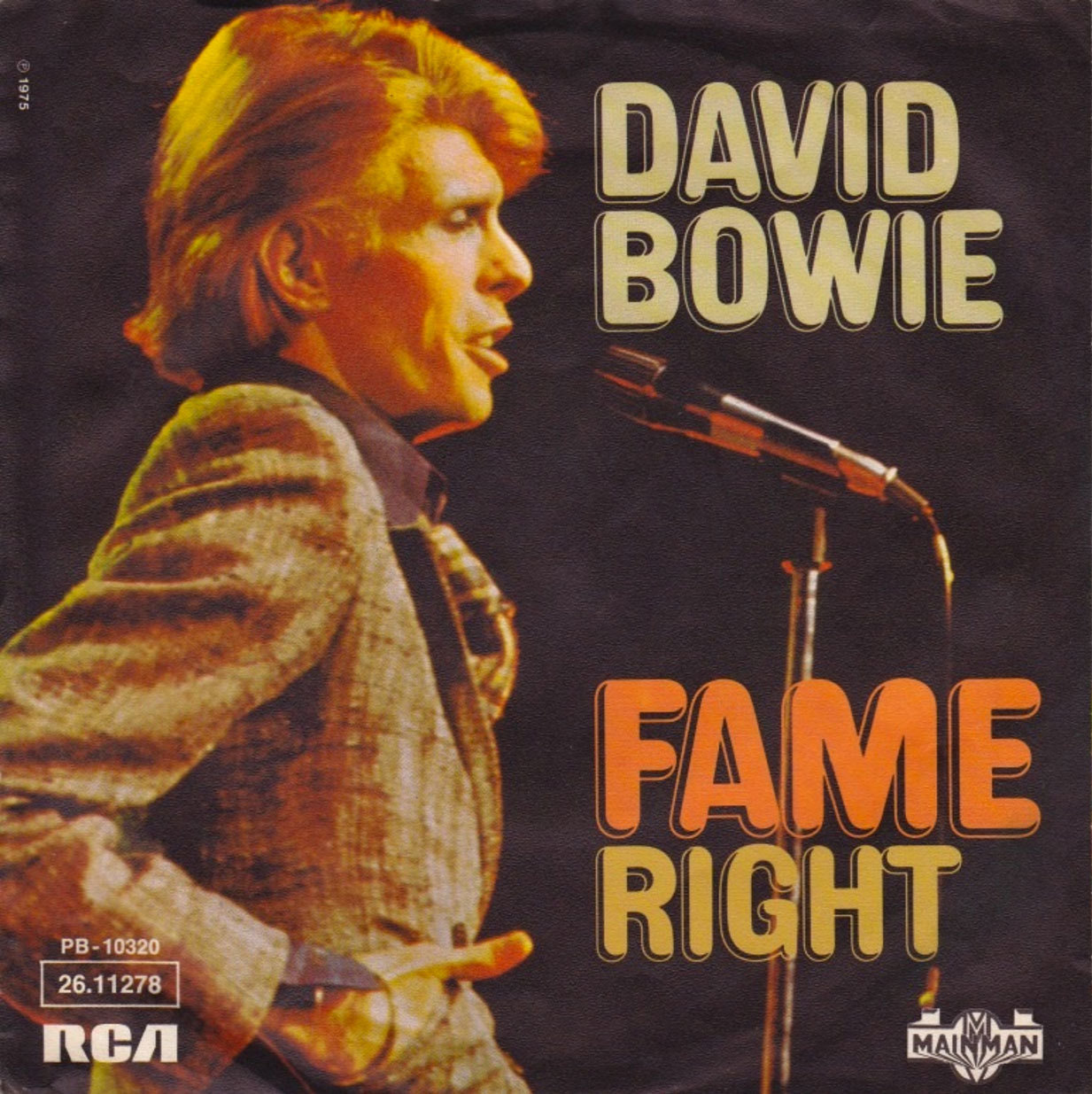
- David Bowie – Fame b/w Right – 1975 German release
-

- David Bowie – Fame 90

CHARTS
‘Fame’ Chart Positions
| Chart | Peak position |
|---|---|
| Belgium | 17 |
| Canada | 1 |
| Hungary | 12 |
| Netherlands | 6 |
| Norway | 9 |
| UK | 17 |
| US | 1 |